
Tear-outs, approaches & widening
Concrete Driveways in Norman, OK
A firm base, the right thickness and steel where it counts, so the driveway holds up when the clay underneath moves.
- Free on-site measuring visit
- Itemized written estimate for every job
- Base, steel and joints planned for Oklahoma clay
Driveways That Stay Flat on Shifting Ground
Concrete driveways in Norman take more abuse than any other slab on the lot. They carry the cars every day, they catch roof water from the garage, and they sit on clay that swells in a wet spring and shrinks in a dry August. Most failing driveways we see follow the same pattern: cracks running off the corners, a panel near the garage that has dropped and holds water at the door, and an approach at the curb that has broken up.
Signs it is time to replace
- Cracks wide enough to catch a coin, or cracks where one side sits higher than the other
- A panel that has sunk toward the garage or tilted toward the house
- Water standing on the driveway or running toward the foundation after a storm
- A broken or crumbling approach at the curb
- Surface flaking and pitting over large areas
- A drive too narrow for the cars you have now
A single sunken panel on an otherwise sound driveway can often be lifted. When settling, wide cracks and a broken approach show up together, replacement usually costs less over time than patching year after year.
What goes under the concrete
Most driveway problems start below the surface. We break out and haul off the old concrete or asphalt, dig out soft or organic soil, and replace it with crushed stone compacted in layers. On clay ground that base does two jobs: it gives the slab even support, and it keeps water from pooling against the clay, which is what makes the clay swell.
Thickness depends on use. HomeGuide's driveway guide calls for at least 4 inches for ordinary cars, 5 to 6 inches for RVs or heavy vehicles, and thicker edges of 6 to 8 inches. If a boat, camper, work truck or trailer parks on the drive, we thicken that area.
Rebar on chairs at mid-depth ties the slab together, so when clay movement does crack it, the pieces stay level instead of drifting into a step. Joints are cut on a planned grid so cracks follow straight lines.
The approach and the city side
The approach is the section between your driveway and the street, usually crossing the public sidewalk. In Norman that section is in the city's right-of-way. The city's Sidewalk Program and Policy says curb damage caused by a driveway approach is the owner's responsibility, that a sidewalk permit is required for any sidewalk construction, and that a contractor hired by the owner applies for an offsite construction permit. Our estimate shows where your private driveway ends and the approach begins.
If your home is in the city's Core Area, has curb and gutter, and has a gravel or badly damaged driveway, the Driveway Repair Program may reimburse part of the cost. The program form notes that a typical approach is about 10 feet wide and 12 feet deep with 5-foot curb returns, that applications are scored after the end of April, and that an application is denied if the old drive has already been torn out. Call Engineering at (405) 366-5315 before any demolition.
Finish options
- Broom finish: the standard, with a light texture that grips in rain.
- Exposed aggregate: the top paste is washed away to show the stone, which hides tire marks.
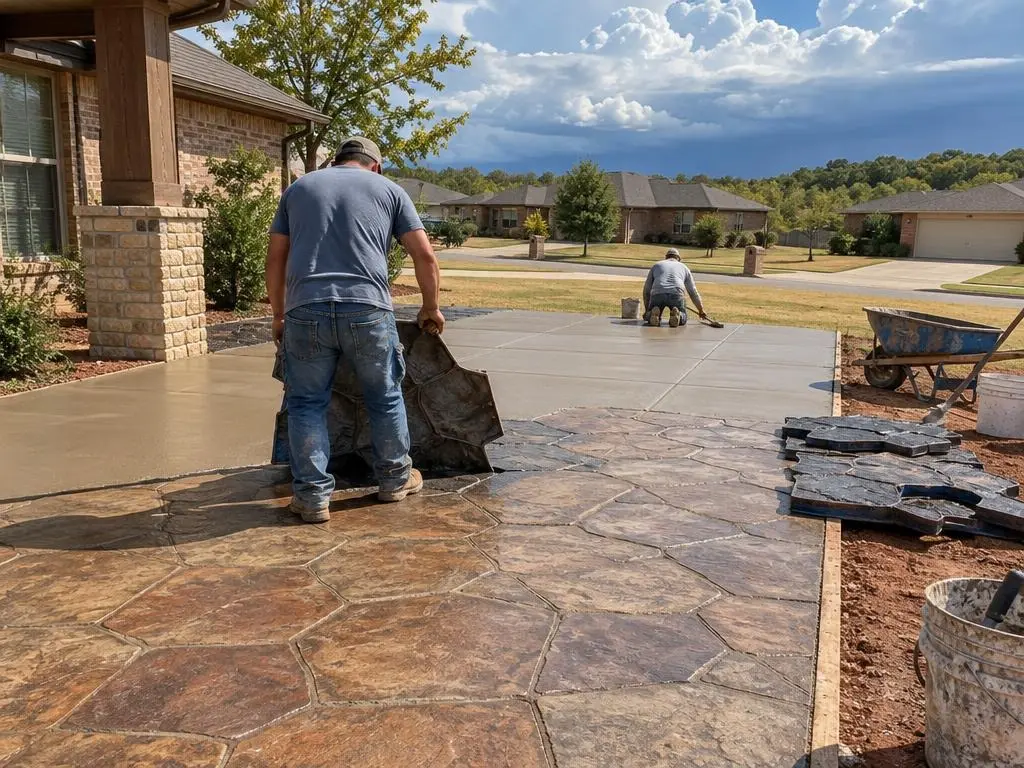
- Stamped or colored borders: a decorative band along the edges with plain lanes down the middle.
- Smooth trowel: clean looking but slick when wet, so we keep it off sloped drives.
Your first year with the new driveway
Stay off it with cars for at least 7 days. HomeGuide recommends waiting 28 to 30 days before the first coat of sealer, then resealing every 2 to 3 years. Turn downspouts away from the slab edges and keep sprinklers from soaking one side of the driveway while the other side stays dry, since uneven moisture is what makes clay lift one part of a slab and not the other.
What the Driveway Estimate Covers
Each line below is priced separately on your written estimate.
Tear-out and hauling
The old concrete, asphalt or gravel removed, along with soft soil underneath.
Stone base
Crushed stone placed and compacted in layers for firm, even, draining support.
Grade and forms
Forms set so water runs away from the garage, the house and the slab edges.
Rebar
Steel set at mid-depth and sized to the driveway and the vehicles on it.
Pour, finish and joints
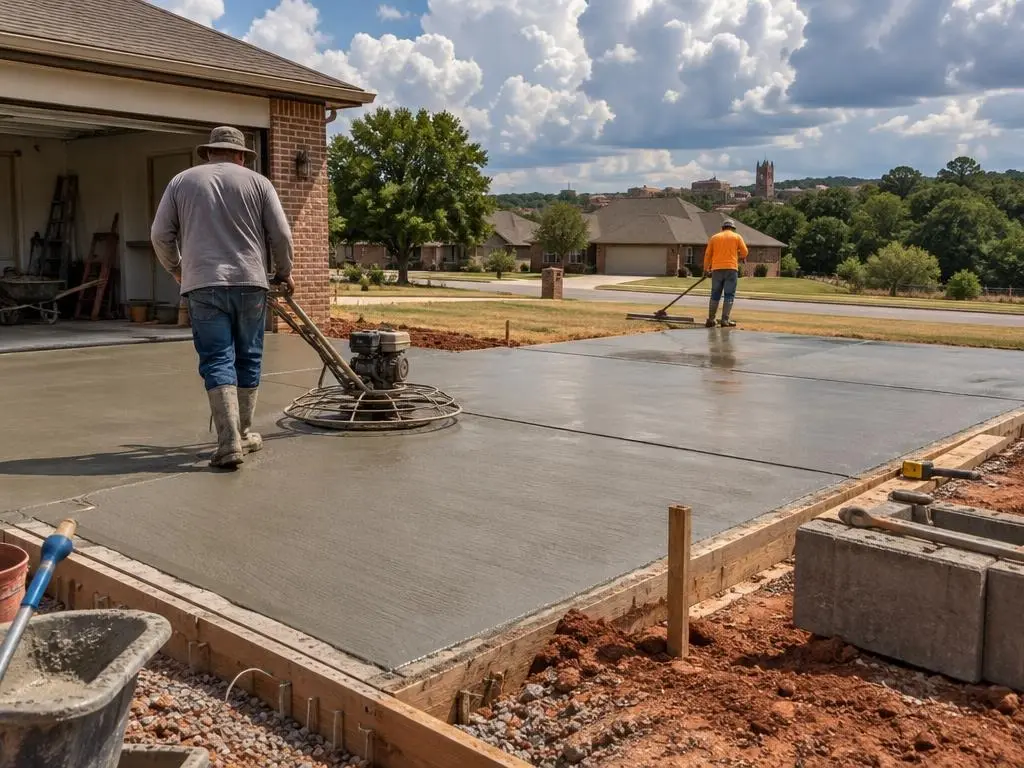
Concrete placed, broom finished and jointed on a planned layout.
Approach and extensions
Curb approaches, wider entries and parking pads tied into the existing slab.
Typical Concrete Driveway Costs
| Item | Published range |
|---|---|
| Standard driveway, per sq ft installed | $6 to $10 |
| One-car, 12 x 24 ft | $1,700 to $4,300 |
| Two-car, 20 x 20 ft | $2,400 to $6,000 |
| Two-car, 24 x 24 ft | $3,500 to $8,600 |
| 6-inch slab, per sq ft | $8 to $20 |
| Old driveway removal, per sq ft | $2 to $6 |
| Rebar, per sq ft | $1 to $3 |
Figures from HomeGuide's concrete driveway cost guide (national averages, not Norman quotes). Soil, access, thickness and finish all move the total. Your written estimate after we measure is the price.
Start to Finish
1. Measuring visit
We measure, check drainage and the approach, and give you a written estimate.
2. Permits and locates
City permits for the right-of-way and 811 utility locates are handled before digging.
3. Tear-out and base
The old drive comes out, soft soil is removed and stone is compacted.
4. Pour and cure
Rebar, concrete, finish and joints, then a written schedule for driving and sealing.
Why Choose Us for Concrete Driveways
Sized for what you park
Extra thickness where trucks, trailers or campers sit.
Approach marked
You see which part is private and which is in the right-of-way before you sign.
Concrete Driveways Questions
How long does a concrete driveway last?
HomeGuide's cost table lists 30 to 40 years for a well-built, maintained concrete driveway. In Norman the base, the reinforcement, drainage and how evenly the soil stays moist decide where in that range a driveway ends up.
How thick should my driveway be?
HomeGuide puts the minimum at 4 inches for cars and 5 to 6 inches for RVs or heavy vehicles, with edges of 6 to 8 inches. On clay soil we lean toward the thicker end where heavier vehicles park and at the approach.
Can you pour over my old driveway?
We rarely recommend it. New concrete over a cracked, sunken driveway picks up the same cracks and movement, and it raises the surface at the garage door and the curb. Removing the old slab and building a proper base lasts longer.
Will the City of Norman help pay for my driveway?
Possibly, if your home is in the Core Area, has curb and gutter, and has a gravel or badly damaged driveway. The Driveway Repair Program scores applications after the end of April and denies any where demolition has already happened, so apply first by calling Engineering at (405) 366-5315.
How soon can I park on it?
HomeGuide says at least 7 days for cars and the full 28 to 30 day cure for heavy vehicles. We give you exact dates for your driveway.
Concrete Driveways Service Areas
- Concrete Contractors in Norman, OK
- Concrete Contractors in Moore, OK
- Concrete Contractors in Oklahoma City, OK
- Concrete Contractors in Midwest City, OK
- Concrete Contractors in Del City, OK
- Concrete Contractors in Mustang, OK
- Concrete Contractors in Newcastle, OK
- Concrete Contractors in Choctaw, OK
- Concrete Contractors in Blanchard, OK
- Concrete Contractors in Noble, OK
- Concrete Contractors in Tuttle, OK
- Concrete Contractors in Purcell, OK
- Concrete Contractors in Harrah, OK
- Concrete Contractors in Slaughterville, OK
- Concrete Contractors in Goldsby, OK
- Concrete Contractors in Bethany, OK
- Concrete Contractors in Spencer, OK
- Concrete Contractors in Tecumseh, OK
- Concrete Contractors in Nicoma Park, OK
- Concrete Contractors in Lexington, OK
- Concrete Contractors in Washington, OK
Get a Concrete Driveways Estimate
We measure your driveway and price it in writing, in Norman and nearby Cleveland County towns.